
To the content To main menu

Month: August 2026

Sustainable dosage, economical dishwashing: Green Care professional launches ENERGY All-in-One

Use less, achieve more: with the new Energy gel All-in-One, Green Care Professional demonstrates how sustainability and cost-effectiveness can be consistently combined in the professional dishwashing process.

This dishwashing gel has been developed for everyday professional use and really comes into its own in office and staff kitchens, bars, cafés and small catering establishments with small, domestic-style dishwashers. It reduces the amount of detergent used to the absolute minimum – thereby lowering both the environmental impact and operating costs.

The focus is on a formulation that allows for a dosage tailored to requirements, starting from as little as 16 ml (half a dosing chamber). Thanks to this flexible adaptation to the actual level of soiling, only as much product is used as is really necessary. For users, this means not only significant savings on detergent, but also a reduction in the overall cost per wash cycle.
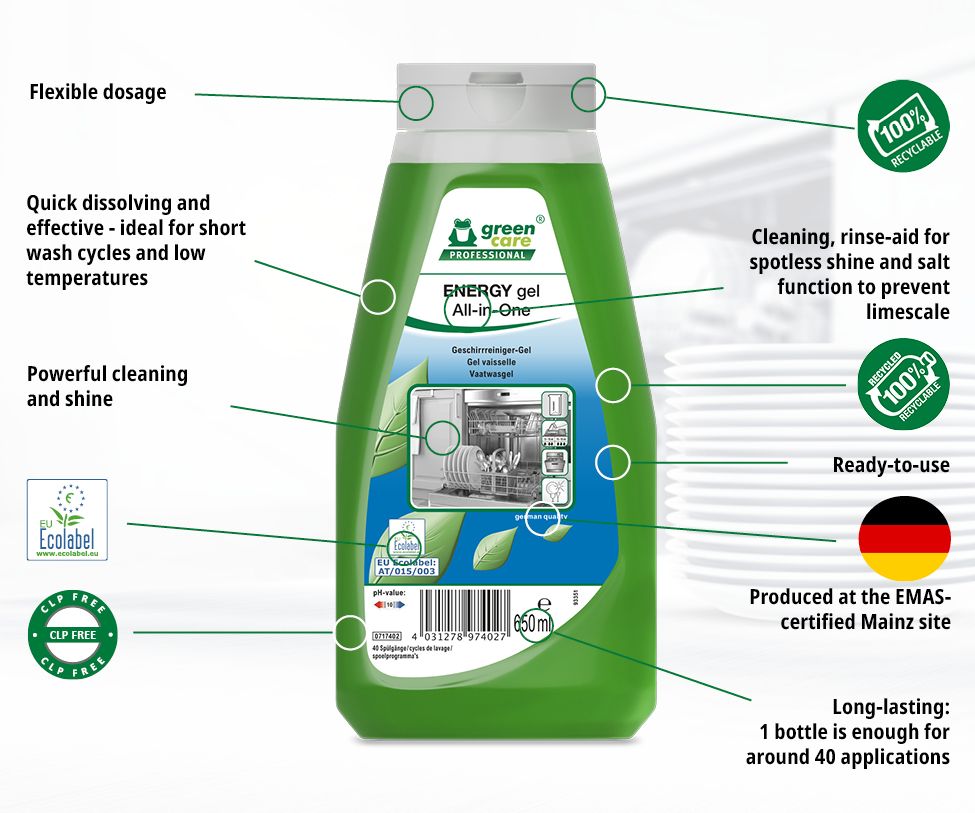
Economical in use and sustainable dosing in one. © Tana-Chemie GmbH

At the same time, the gel’s rapid solubility helps to make cleaning processes significantly more efficient. Energy Gel All-in-One takes effect particularly quickly, meaning that even short wash cycles can be used reliably. Combined with low washing temperatures, this leads to a significant reduction in energy and water consumption – a crucial advantage in times of rising operating costs and increasing sustainability requirements. Yet efficiency does not come at the expense of performance: the cleaner reliably removes grease, tea and coffee residues as well as encrustations, ensuring sparkling results on crockery, pots and pans.

The CLP-free formula is particularly user-friendly, and not just because it is easy to dose. The integrated all-in-one function, which combines cleaning, rinse aid and limescale protection in a single product, also simplifies the process. It is only recommended to add salt and rinse aid when the water hardness reaches 21° dH or higher.

At the same time, the cleaner meets high environmental standards – not least through its EU Ecolabel certification and its packaging made from 100 per cent recycled material.

With its combination of a dispenser bottle, sustainable practices and cleaning performance, Energy gel All-in-One is fully aligned with Green Care Professional’s strategic focus: to develop sustainable solutions that are not only environmentally sound but also offer clear economic added value for professional users.
Sustainability Starts at the Source

Taking another step toward holistic circular economy, Green Care Professional – the professional brand of the Werner & Mertz Group — is systematically increasing the proportion of surfactants derived from European raw materials in selected cleaning products. The goal is to advance sustainability not only in product use and packaging but consistently throughout the entire value chain.
Taking

© Tana-Chemie GmbH

Taking Sustainability to the Next Level

For decades, Tana-Chemie has been synonymous with sustainable innovation in the cleaning industry. With the increased use of European surfactants, the origin of the raw materials used is now taking center stage more than ever.

“Surfactants are key components of cleaning products. While they have traditionally been based on fossil or tropical raw materials, Green Care Professional is increasingly turning to plant-based
alternatives grown in Europe — such as canola, sunflowers, olives, or lineseed,” explains Melina Goeth, Product Manager at Tana-Chemie.

Clear Environmental Benefits

The use of European surfactants brings measurable benefits for the environment and climate:

  • – Shorter transport routes within Europe reduce CO₂ emissions
  • – Renewable raw materials replace fossil sources
  • – Regional agriculture and value creation are strengthened
  • – Dependence on global raw material markets is reduced
  • – Less pressure on tropical croplands

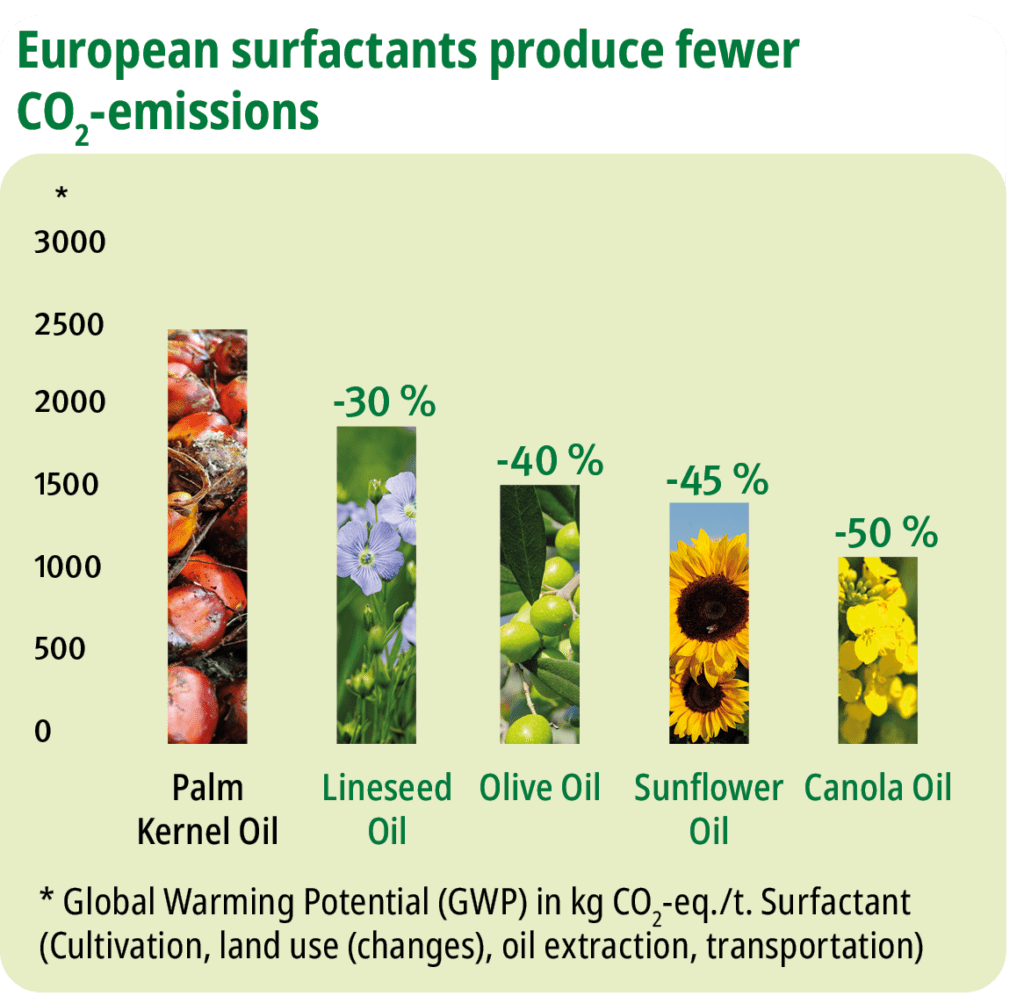
Studies show that surfactants based on European oilseeds — such as canola or sunflowers — can significantly reduce CO₂ emissions compared to tropical alternatives.

© Tana-Chemie GmbH

Products with Over 90% European Surfactants as Milestones

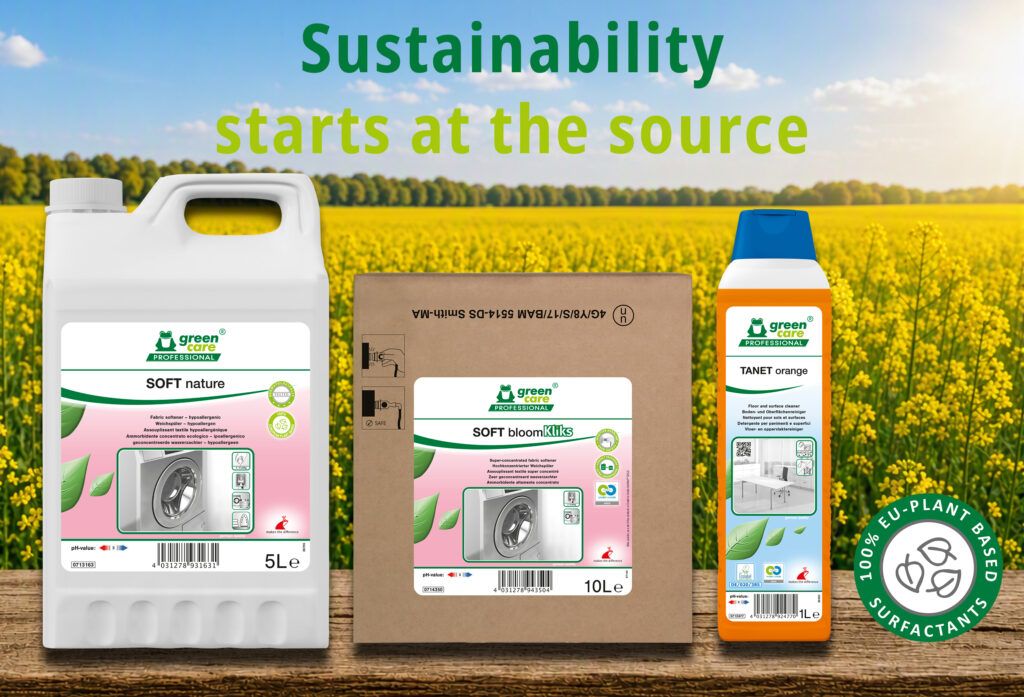
SOFT bloomKliks have achieved a content of over 90% European plant-based surfactants in their formulations. TANET orange already contains 47% renewable European surfactants.
A complete transition to European surfactants is not yet possible in all applications. Reasons for this include specific performance requirements and properties. Tropical vegetable oils (palm kernel oil, coconut oil) primarily provide C12–C14 fatty acids, whereas European vegetable oils (canola, sunflower, olive, flax) primarily provide C16–C18 fatty acids. Simply put, this results in surfactants with carbon chains of varying lengths. Together with the hydrophilic and lipophilic parts of a surfactant, these influence important properties such as foaming, cleaning performance, stability, and skin compatibility. The different fatty acid composition is therefore a key reason why European surfactants cannot always replace existing solutions on a 1:1 basis. If a surfactant is replaced, the entire formulation often needs to be adjusted as well.

Green Care Professional addresses this challenge with a step-by-step approach and targetedformulation development: Surfactants are specifically used where their properties best suit the formulation and achieve the greatest long-term impact, while maintaining the same high cleaning performance. “Sustainability and performance need not be a contradiction. Our customers expect high-performance products and that’s exactly what we deliver, while continuously increasing our contribution to sustainability,” explains Goeth.

Conclusion: Another Step Toward a Circular Economy

By increasing its use of European surfactants, Green Care Professional underscores its role as a pioneer in sustainable cleaning solutions. The focus on regional raw materials, reduced emissions, and innovative formulations shows that sustainability doesn’t end with the finished product — it begins with the raw materials.